
 Joy Hutchinson has diligently been serving both youth and adult volunteers as Chair: National Adult Support for many years. Her term has come to an end, and we want to thank Joy for her enormous contributions to bettering our support to the volunteers that make Scouting possible.
We are now pleased to announce that Paul Innes will be taking over the helm of Chair: National Adult Support. Paul has years of experience in supporting our adult volunteers as RTC: Adult Support for the Western Cape, as DC for two Districts and as a National IT Support team member. Prior to this, served as Troop Scouter and Scout Group Leader for 1st Bothasig in the Western Cape. Paul’s dedication to Scouting and supporting volunteers is clear to all who know him, but where did his passion for Scouting begin.
“My Scouting journey began as a Cub at 1st Thornton, transitioning to Scouts at the same Scout Group. During my high school years, I moved to Somerset West, where 2nd Somerset West became my new Scouting home. Around 1986, I joined the Area Band, staying until it closed. Some of my fondest memories come from touring with the band—first to the “Transvaal” in 1987, and later to Namibia around 1990. Though I never pursued the Springbok Award, I achieved my First Class. Scouting taught me invaluable skills: public speaking, patience, and effective training. Who I am today is largely shaped by my experiences in Scouting”, explains Paul with a smile.
 “As a young adult leader, I volunteered with several Groups like Parow and Goodwood, ultimately settling at 1st Bothasig in 1996. There, I began as an Assistant Troop Scouter (ATS), later becoming Troop Scouter (TS) and eventually Scout Group Leader (SGL). When the District Commissioner (DC) stepped down, other SGLs in the District encouraged me to step into the role, even though I was the youngest. I served as District Commissioner for the Tablebay District and helped the Atlantic District. It was then that I saw the real need for supporting adults in Scouting”, adds Paul.
Having grown up in Scouting, Paul never feared taking on leadership roles to support the growth of others. “As Troop Scouter I became deeply involved in Regional activities, including supporting Springbok Scouts in the Western Cape. But, over the years, one of the greatest privileges for me in Scouting has been watching young Scouts enter the Troop at 11 years old and now seeing them in their 30s, thriving in their lives. Whether or not they earned their Springbok, they have grown into successful, confident individuals. I’ve long believed Scouting should be compulsory for youth as it shapes character in ways that those who never experience it may never truly understand.”
 More recently, Paul has been dedicated to improving the adult volunteer experience both Regionally and Nationally. “Managing volunteers comes with unique challenges. I’ve learned, maybe a little too late, that taking on too many roles leads to burnout. This realisation led to my appointment as the RTC Adult Support for the Western Cape, allowing me to step away from my previous roles while still remaining engaged. My son’s upcoming transition into the Troop was also a factor as I wanted to give him space to experience Scouting independently. Former Regional Commissioner and a mentor to me, Paddy Milner, once remarked, “You want to be involved but take a break…”. ‘The break’ marked the beginning of my journey into the Support side of Scouting—an entirely new world I hadn’t explored before.
Today, I find great fulfilment in helping people navigate Scouting. Understanding their challenges and finding solutions mirrors my approach in my professional role. Helping one person often creates a ripple effect, benefiting many more. Introducing IT support within Scouting was another initiative I felt was needed as it was something we had lacked before but has ultimately benefited all.”
 Over the years Paul has gained the experience, has acquired the knowledge, and now, is ready to give back to leaders nationwide as National Chair: Adult Support. “One of the biggest areas where adults need assistance is navigating processes, policies, and procedures, as well as learning to use the various systems available to them. Rather than reinventing the wheel, my goal is to streamline existing processes and transition them into the digital world. Scouting still involves lots of paperwork, but while safety for youth remains a top priority, I aim to optimise how we manage administrative tasks.”
When asked how he aims to enhance adult support in communities with weaker structures or limited access to technology, he takes a moment to reflect and says: “The reality is that nearly everyone has a cell phone today. We need to start leveraging this resource effectively. A major step forward would be demonstrating how a phone can simplify Scouting tasks. Working closely with the IT Team, we should focus on developing user-friendly applications that make administration easier. Imagine being able to click a button on your phone to generate a consent form, submit a service award application, or streamline reporting. Therefore, I want to encourage collaboration between Adult Support and IT. It is our strategic goal as Adult Support to enhance the volunteer experience, and I believe that IT can create the tools that make the journey smoother.”
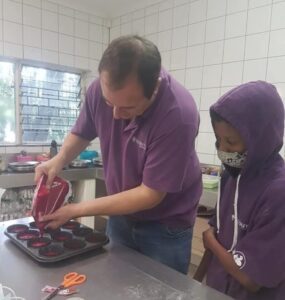 When not volunteering for SCOUTS South Africa, Paul works full-time as a Senior IT Technician for the City of Cape Town, specialising in front-end support. He also serves on the Ward Committee, representing the Youth Sector, with a focus on Scouting, and is the Treasurer on his son’s High School Governing Body. Over and above these roles, Paul also volunteers with Law Enforcement Services, coordinating a team of volunteers. “My Patrols usually take place on Friday evenings, though my schedule varies depending on the needs of the community. If you ever see me in a blue uniform, make sure you’re following city regulations!”, he quips.
So how does it do it all? “Balancing is the key to ensuring family time, work commitments, and volunteer responsibilities are managed effectively. While life can get in the way of Scouting, adaptation is part of the journey. These days, most meetings are conducted online, allowing me to be home throughout the week when I’m not attending one. Also, having a family involved in Scouting makes the experience much easier! They understand and support the commitment. My two sons are both active in Scouts, while my wife, though not directly involved in a Group, provides administrative support at the Regional level”, he concludes.